Louis Budenz was an American activist and writer, as well as a Soviet espionage agent and head of the Buben group of spies. He began as a labor activist, and a member of the Communist Party USA. He became a member of the National Committee of the Party and held various editorial positions at its newspaper, the Daily Worker, from 1935 to 1945.
In 1945, Budenz renounced communism, returned to the Roman Catholic Church, and became an anti-communist advocate. He became an informant for the FBI and testified as an expert witness at various trials of Communists and before many of the Senate and House committees that were formed to investigate Communists.
By his own estimate, Budenz spent some 3,000 hours explaining the Communist party's "inner workings" to the FBI, as well as testifying on 33 occasions to various committees. In 1952, Senator McCarthy would praise Budenz for having "testified in practically every case in which Communists were either convicted or deported over the past 3 years; one of the key witnesses who testified against... Communist leaders."
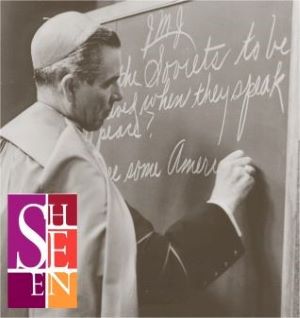
Arbishop Fulton Sheen played a principal role in the conversion of Budenz. Budenz claims in This Is My Story that all through his Communist years he sought to reconcile Communist doctrine with Catholicism; by 1945 this reconciliation appeared impossible, and he contacted Monsignor Fulton Sheen about rejoining the Church. Sheen encouraged him. Without letting his Communist comrades even suspect his approaching defection, on October 10, 1945, Budenz was received back in the Church at a ceremony in St. Patrick's Cathedral. The next day he took up a professorship at Notre Dame.
Sheen tipped off Hoover in advance about this defection, so the bureau was ready to move rapidly in debriefing Budenz. Budenz was wary about talking to the FBI; he was afraid that if word got out to his former Party associates, his personal security would be jeopardized. If he agreed to talk, he wanted Catholic agents to interview him. Sheen checked out this request and was assured that the bureau would maintain confidentiality.
Archbishop Sheen’s relationship with Louis Budenz began in 1937 when, in a Daily Worker article, Budenz publicly invited Catholics to join forces with Communism in the interest of world peace. Fulton Sheen answered him in a pamphlet in which he said: "I am convinced that the greatest propagandists of Communism know practically nothing factual about it. They talk of Russia either in general terms or in the stereotyped language of its propaganda. That is why I believe many Communists are in good faith, and here I include you, Mr. Budenz."
Not satisfied with this, the Monsignor arranged to meet Budenz personally in a New York hotel. At dinner together, Budenz started to argue in favor of the democratic merits of the new Soviet Constitution. But, as he later confessed, "Monsignor Sheen knows the secret of dealing with people who have broken with the Church...Pushing aside the remaining cutlery on the table as though to waive any argumentation, Monsignor bent forward and exclaimed: 'Let us now talk of the Blessed Virgin!'"
This was the beginning of the end. Budenz continues: "Immediately, I was conscious of the senselessness and sinfulness of my life as I then lived it. The peace that flows from Mary, and which had been mine in the early days, flashed back to me with an overwhelming vividness. There rang in my ears for a moment the prayer which comes from the salutation of Gabriel: 'Ave Maria, gratia plena.' How often, I thought, has that supplication gone up from thousands in distress and brought them peace - and I, who know better, reject it!"
It took six more years of persistent effort, patient correspondence and prayer, but finally Budenz returned to the Church, and has since become one of the star witnesses before the American Congress in its fight against Communism in the States.
After spending so many years writing articles and pamphlets in support of Communist causes, after 1945 Budenz wrote several books about the dangers and evils of Communism. He also became a syndicated columnist, Catholic professor and lecturer. In 1947, he wrote an autobiography, This Is My Story. He died in Newport, Rhode Island, survived by his wife Margaret and four daughters.
Sources:
Hardon, John, S.J. “Archbishop Fulton J. Sheen – Author, Orator, and Missionary.”
17 April 2007 <http://www.intermirifica.org/sheen.htm>.
Wikipedia. “Louis F. Budenz.” 17 April 2007 <http://en.wikipedia.org/wiki/Louis_F._Budenz>.
Newman, Robert P. Owen Lattimore and the "Loss" of China. Berkeley:
University of California Press, c1992
<http://ark.cdlib.org/ark:/13030/ft296nb15t>.
Back to Notable Converts Page